by Janine Duffy
There’s a lot of information online about how to provide water for wildlife, but different animals use water differently. Wild animals may need water for drinking, bathing and/or cooling off. Some also use water to help their feeding. This article will focus on water for cooling off and drinking on hot days.
This article provides case studies, followed by explanations of the behaviour, so you can apply the best water solutions to suit your wildlife, on your property, your backyard or balcony.
The anecdotes through this article have come from my first-hand or shared experiences. During my 30 year career as a wildlife tour guide, I’ve been in the Bush on many days of extreme weather. As a koala researcher and wildlife carer, I’ve also been in the bush to help animals suffering from extreme heat.
This is part 2 in a series on providing water for wildlife. Read part 1 here.
Mammals using water to cool down
Case Study 1. March 9 to 11, 2024: Local temperature* 40.3°, 40°, 38.1°C
Note: the local temperature is from the nearest BOM weather station at Avalon airport on the coast. In the You Yangs it is often several degrees hotter.
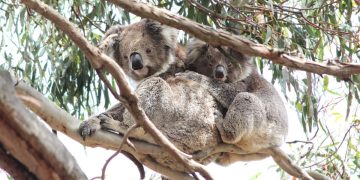
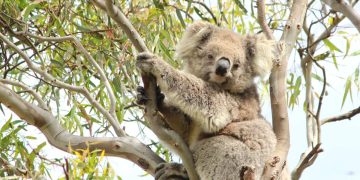
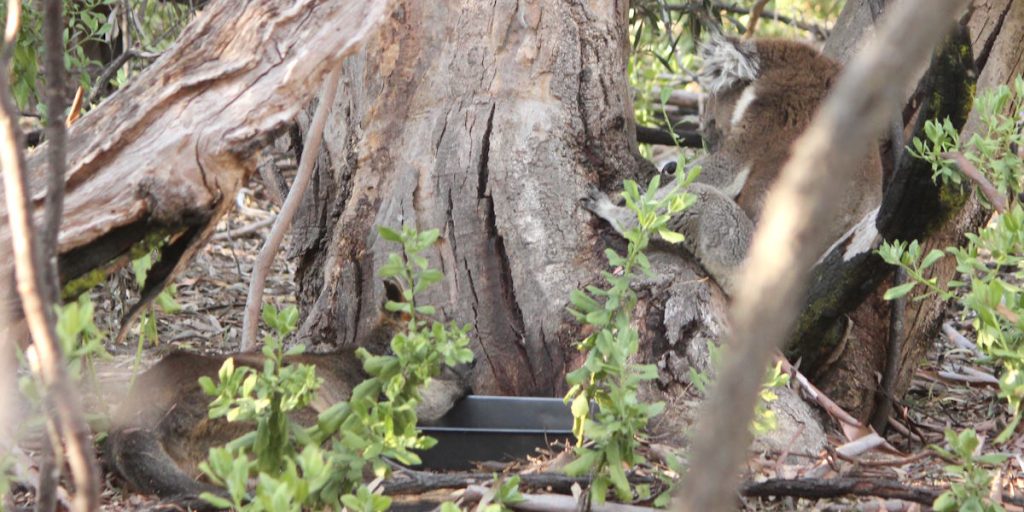
“It was so hot that unusual things happen. There was Gulli, our dominant male koala, in the lowest fork of a Red Gum just centimetres from the ground. Beside him was a male Swamp Wallaby, his left arm submerged in a shallow tray of water. Both males were drowsy, their eyes half-closed, but so uncomfortable that they couldn’t sleep. The overheated wallaby shifted position slightly, causing Gulli to start, tensing his arms ready to climb.
I sensed that they were sharing space with reluctance – each nervous at the closeness of the other. Though they live in the same habitat, it’s rare to see koalas and wallabies really close. Both species are pretty solitary, one is arboreal, one terrestrial.
I was close enough that the wallaby, at least, should have been upright and nervous. But extreme heat makes wild animals lethargic, and very, very vulnerable. Reluctantly, I moved closer to fill the water, disturbing the wallaby, who hopped away a few paces. But he returned shortly after I moved away.”
Watch: https://youtu.be/NNnBrzAJWog
……………………………
On days of extreme heat, many wild creatures will go to water if it’s available, and if they can. Water is nature’s cooling system. Large bodies of water are cooler than the air temperature, and submerging all or part of a body cools it down. The air and the ground around a waterhole are cooler too.
For all animals, overheating is a threat to life. In humans we call it heat stroke. It occurs when our body temperature goes out of the safe range of 36.1° to 37.2°, and past 40°. That’s just 3 degrees between safe and deadly. If untreated, heat stroke is fatal. Even mild cases (heat exhaustion) can be fatal if not treated.
Wild mammals have pretty similar body temperatures to humans, but some have a bigger range of safe temperature:
Western Grey Kangaroo: normal body temperature 36°C,
Koala: normal body temperature 36.3°C, safe range: ~2.4° (but 32.4° to 40.8°C recorded in Mella 2024)
Bare-nosed Wombat: normal body temperature 34.7°C (Triggs 1996)
Grey-headed Flying-fox: normal body temperature 36°C (Hall 2000)
All animals can suffer heat stroke if their body temperature exceeds a threshold (the upper thermal limit UTL or heat tolerance limit HTL, or critical thermal maximum CTM) .
For a wild animal on an extremely hot day, overheating must be avoided at all costs. But their options are limited. They might have access to shade, but that might not be enough. They might have behavioural adaptations, like panting (birds), sweating, licking their paws (kangaroos), blowing snot bubbles (echidnas), gular fluttering (goannas), wing fluttering (birds) but many of these behaviours use water and energy.
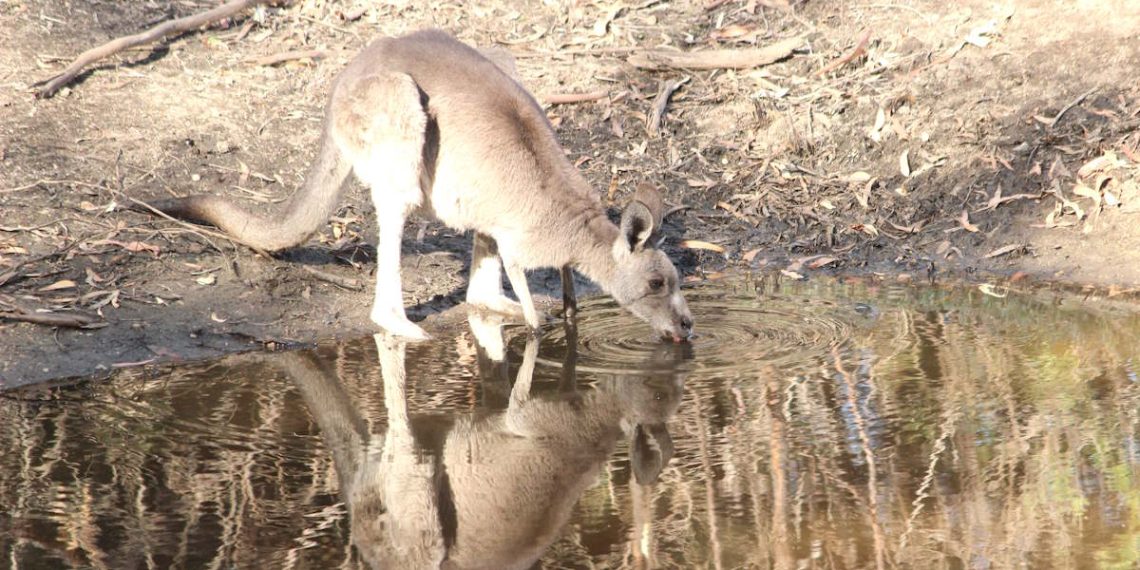
Some animals will fully or partly submerge to cool their bodies on hot days. I’ve seen Emus, Eastern Grey Kangaroos, Swamp Wallabies and Koalas sitting in waterholes.
…………………
Case Study 2. January 14 to 18, 2014: local temperature 45.8°, 41.6°, 41.6°, 46.3°C
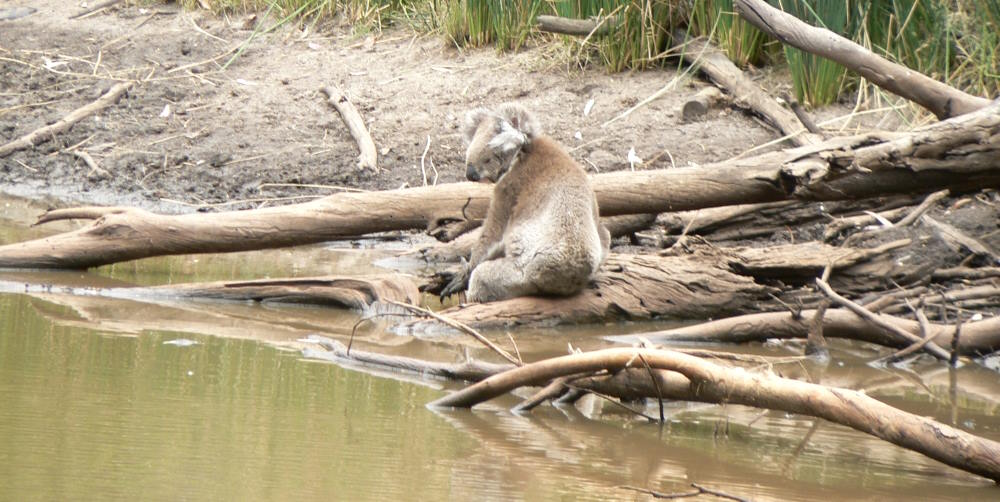
“After four days of unrelenting heat, I stopped to check an unknown female koala who had been found earlier that day, sitting on the edge of a waterhole with her feet in the water.
Together, my team had found a total of 13 koalas that day, and all seemed to be coping, except this one young female. Since 9.45am on day 4 of the heatwave she had been sitting in the dam, barely moving and unresponsive. We hadn’t interfered, as I know that seeking relief in water is a perfectly normal response for a hot animal.
But by 1pm, she hadn’t moved. I approached, slowly, quietly. She watched me all the way, but there was no spark in her eyes. She was in heat exhaustion.
When I was close enough to touch her, and still no spark, I called in a carer.
Over the next few days I expected the worst. The vet would find some underlying condition that had compromised her. She was very young, maximum 3 years old. Why couldn’t she cope, when older koalas had?
Each day she survived seemed a miracle. Then, after two weeks of rest and rehydration and cool, she was fit as a fiddle and ready for release. The vet had done every sort of test and found nothing wrong with her.
The following year, in August, she proved that she was healthy – she had a joey!”
…………………
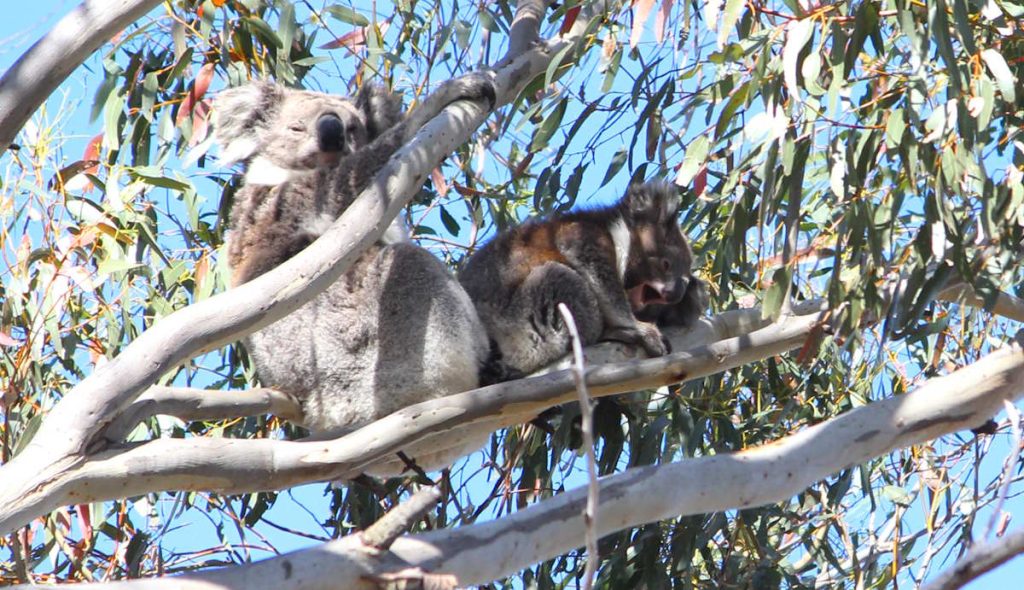
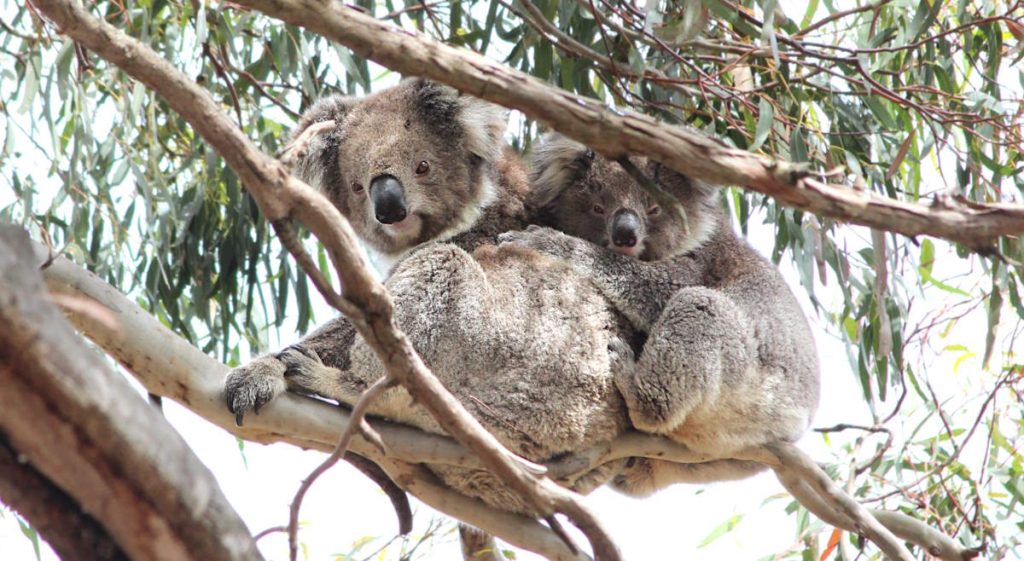
It is possible that she hadn’t coped because she was young. Mature animals often do better in heatwaves than young or old animals.
………………………….
Birds using water to cool down
Case Study 3. January 6, 2018: Local temperature 44.2°C
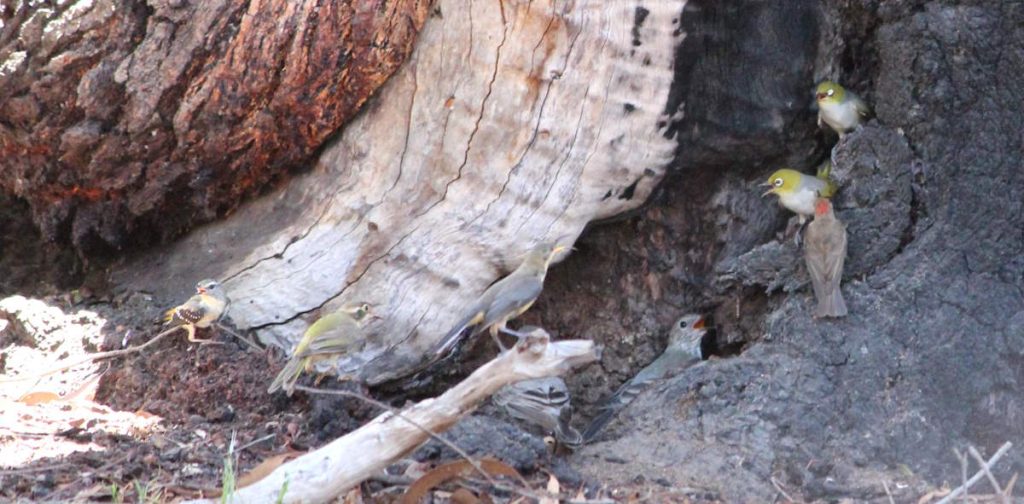
“I was torn. The water tray under the big Ironbark was empty, and I had water to fill it. But around it, in cracks in the bark of the old tree, were some very hot and exhausted birds. To top up the water for them, I would scare them.
Then I saw a sight that helped me decide. A Silvereye lay dead at the base of the old Ironbark, her tiny body still warm.
Above her, her family clung to the bark edges, their beaks wide open. One had his eyes closed, and looked like he might not make it either.
At the bottom of the bark crevice, in the coolest, shadiest spot, a pair of Rufous Whistlers stood, eyes wide in fear. Close by an Eastern Spinebill, a Brown-headed Honeyeater, and a Spotted Pardalote stood, each occupying a slightly hotter microclimate in that order. Near the Silvereyes, a tiny Scarlet Honeyeater clung.
To see so many canopy birds in one spot should have been a delight, but not this time. It was horrific. Only desperation drives these aerial birds to the ground like this.
I filled the water tray. Of course, they all flew away a bit, and I felt awful. But I had to – the heat wasn’t over yet, and – like the little Silvereye – I knew they could all die without the water.”
………………………..
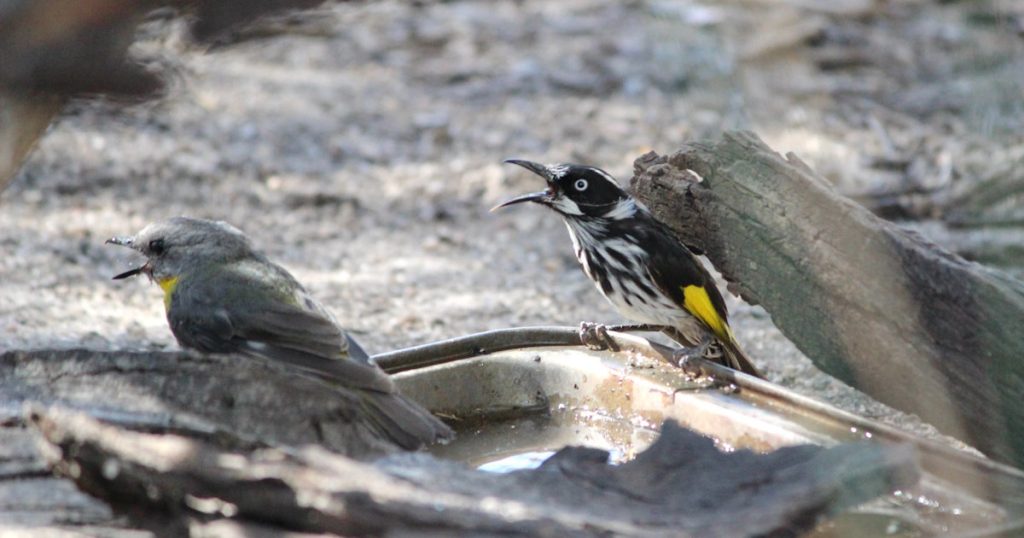
Birds have naturally high body temperatures, and behavioural adaptations to cool themselves on hot days. But they are very sensitive to heat, partly because most of them are day-active, and have small bodies that lose condition fast.
Most birds have a body temperature about 40°C, and may range between 39° and 43°C (McWhorter 2018). But their upper lethal body temperature limit (the temperature that will kill them) is 45° to 46°C, just a few degrees above their normal range.
Doves & Pigeons are the exception – they can tolerate higher temperatures than passerines and parrots. (Pollock 2021)
The behaviour that birds use to cool down uses a lot of energy and water. The open their bills and pant – which loses heat through their mouth, but also loses water – and open and flutter their wings – which costs energy and water. They also stop feeding, which saves energy, but means they lose weight quickly. Read this excellent article by bird expert Gisela Kaplan: https://www.abc.net.au/news/2020-12-11/why-do-birds-stop-singing-when-it-gets-too-hot/12952674
Having access to water improves a bird’s chances of survival enormously.
This excellent, open access article shows that Australia’s dry country birds will suffer tremendous declines during this century, due to heatwaves. But providing water could help a lot. https://doi.org/10.1093/conphys/coaa048
………………………
The importance of drinking water on hot days
Case Study 4. February 7, 2009: the day of the Black Saturday bushfires.
Local temperature: 47.9°C
“The Bush was silent, like all life had ceased. Not even insects could be heard. Occasionally, I heard a crash, as a big eucalypt branch fell to the ground. On the shady side of every big tree, a collection of species could be found: Red Wattlebirds, a Jacky Lizard, Silvereyes and a White-throated Treecreeper at one; Rufous Whistler, Yellow Thornbills, an Eastern Spinebill at another. All the animals were still, with mouths or beaks wide open. All looked terrified.
Inside a toilet block, I accidentally trapped a family of Australian Magpies – as I came in the only door, they flew about, then rushed out squawking. Smart birds like magpies don’t normally put themselves in that position. But they needed the shade and possibly the drips of water from the tap, or the toilet bowl.
On the toilet seats I noticed small dirty footprints. Possums and other animals had been trying to get a drink overnight.
As I drove out of the You Yangs to Little River, I noticed several of the Long-billed Corellas in the sports oval had fallen out of their trees. Most were dead, one was dying. I offered water, but he died in my arms. Above them, the rest of the local flock – which number in the hundreds – were in deep shade in pine trees, wings stretched out, bills wide open, eyes closed. If I’d known more I would have left water for them too.”
………………………………
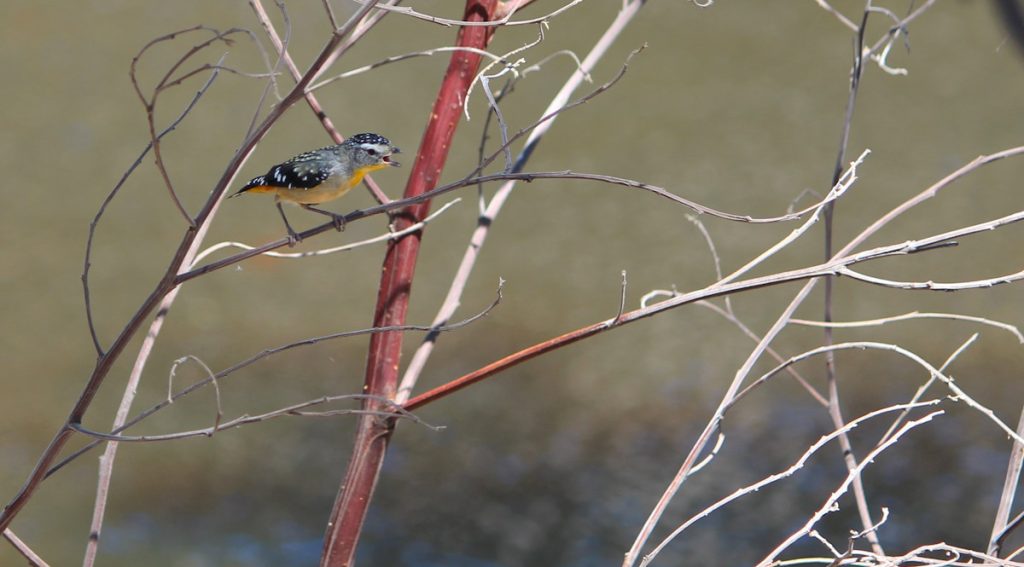
On days of extreme heat, providing drinking water for wildlife will save lives.
Even animals that don’t normally drink free water, will on an extreme day. Animals that normally live high in trees will come to the ground to drink, or to use the cooling effect of shaded earth. They will be nervous, exhausted and lethargic. They have no choice – if they stay up high they will die from the heat.
Every time a wild animal is disturbed in extreme heat, their heart rate goes up, and their ability to cope is compromised. So keep away if you can, go early if you’re refilling water stations, and keep dogs, cats and children away.
………………………….
Case Study 5. December 31, 2007 to January 1, 2008: local temperature 43.2° and 40.9°C
“The first day of 2008 was a scorcher – 40.9°C, after a New Years Eve of 43.2°C. The Millenium Drought was in its 12th year, and wouldn’t break for another two years.
Koala Zelda was a dear little female that we’d known since 2007. She was found on the ground in the morning of 1 January, then a little later she was seen by Guide Bill right beside a waterhole. As he watched, she drank from the water. Then something amazing happened. This incredible, though old, series of photos show the action that is rarely seen in the wild.
Zelda sat up and stayed very still. Quietly, an Eastern Brown Snake moved in from behind her and towards the waterhole. Even reptiles need a drink sometimes.
Zelda waited calmly until the snake left. Then she climbed out of the waterhole and up a tree.”

…………………………….
Not all wild animals need to drink free water, but most will at times, especially if it’s clean and available.
The amount an animal needs to drink depends on their diet, activity levels, water efficiency and whether they are diurnal (day active) or nocturnal. Generally mammals need more water than birds and reptiles. Marsupial mammals are more water efficient than placental mammals.
Though widely believed that koalas don’t need to drink water, our research found that koalas drink rain as it runs down the trunk in all weather conditions, and all seasons (Mella 2020, Flanagan 2025). Other studies have found that the amount of water koalas need can’t always be met by eating foliage alone. (Ellis 1995, 2010, Mella 2019) Koalas are incredibly water-efficient animals, probably able to go for weeks without a drink. But when there’s been no rain for months, and the weather is hot, even koalas may need to drink from a waterhole or puddle.
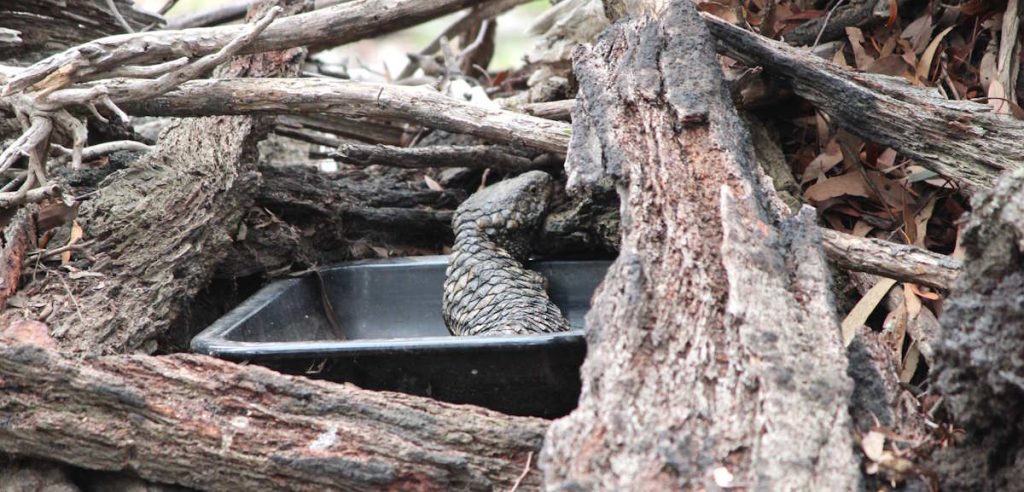
Goannas, lizards, snakes and other reptiles are very water efficient, but they do drink at times, especially in hot weather.
…………………………………
How territoriality affects water use by animals
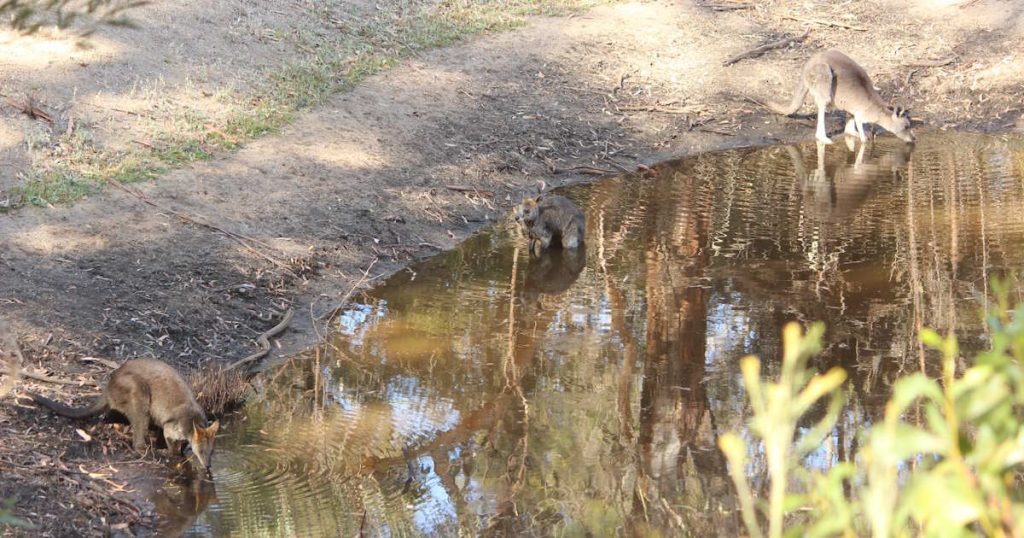
Case Study 6. March 9 to 11, 2024: Local temperature 40.3°, 40°, 38.1°C
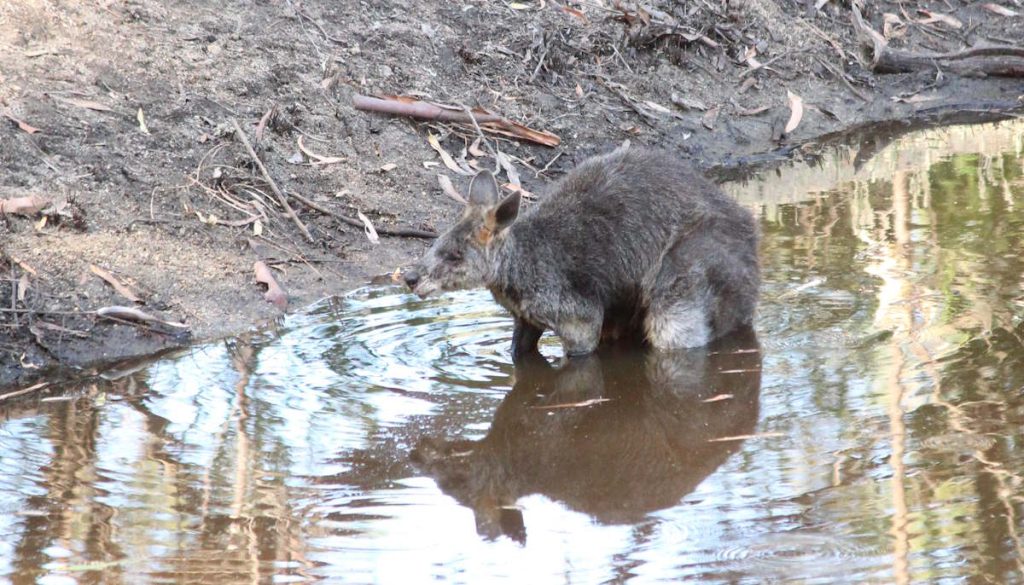
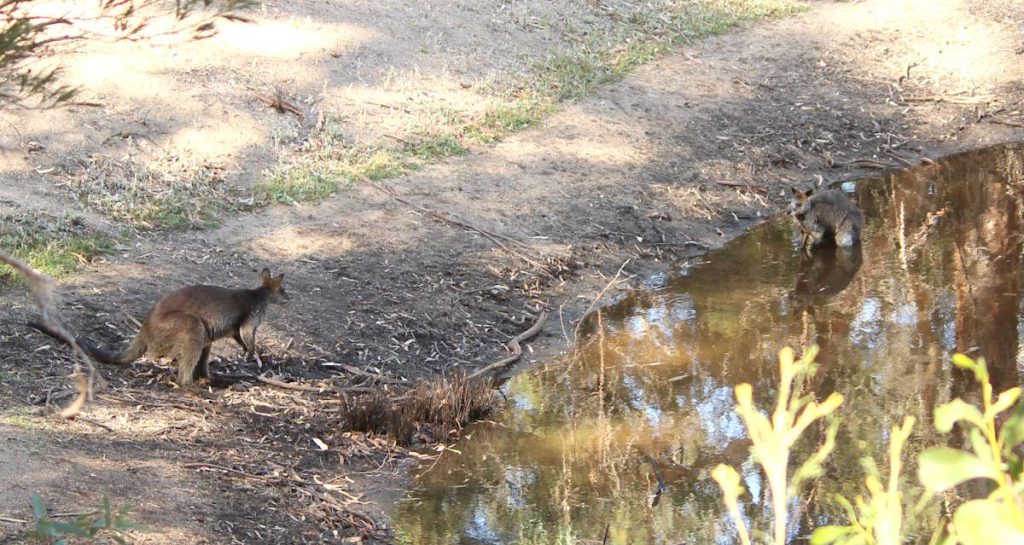
“One of the big waterholes at the You Yangs was still holding a fair bit of water over this hellish three days. In the late afternoon I watched as an old male Swamp Wallaby came to the waterhole, took a drink, then hopped right in until the water was up to his belly. He stayed there for some time, relief on his old face.
An Eastern Grey Kangaroo female came to the waterhole and had a drink. She hardly even looked at the Swamp Wallaby, and he gave her a cursory glance, but then kept his back turned the whole time she drank.
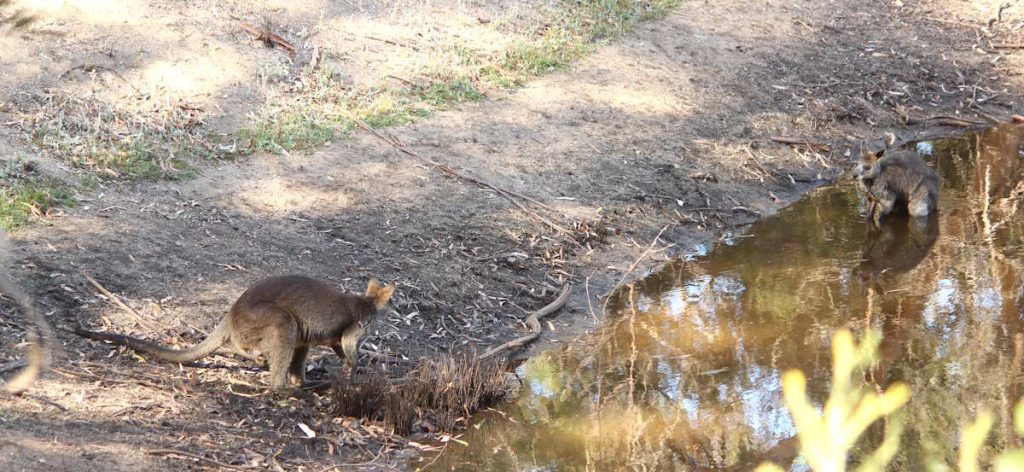
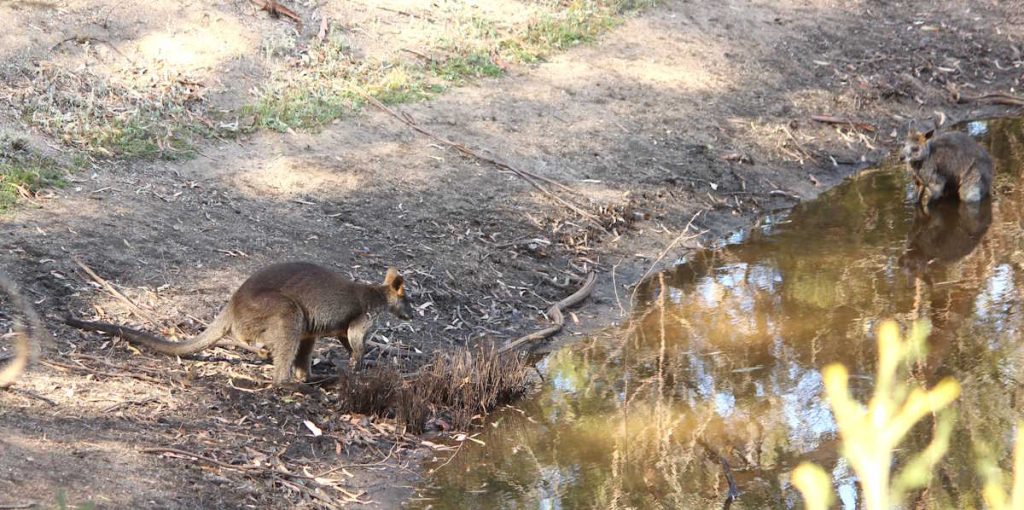
Then, he looked up. His big ginger ears swivelled to full attention mode: another male Swamp Wallaby approached. Unlike the kangaroo, who was a different species and no threat, this was a rival of his own species, and he became very tense.
They eyed each other, tense and wary. The old male stood his ground, well, his waterhole. His old face and body bore the scars of many fights with other males of his kind. Though old, he knew some tricks!
The approaching male was younger, healthy and glossy-looking.
Both males needed the water desperately.
After a tense few moments, an understanding was reached. The younger male approached and drank, but then left. The old male stayed where he was.”
……………………………..
Many wild animals – especially birds – have territories or home ranges that they defend. They have worked hard for it, fought for it, and can’t leave it for long without the risk of losing it. Their home range is their supermarket, their kitchen, their bedroom and their workplace all in one. In most ecosystems there are no spare territories – every one that is habitable is taken, and to get one you have to fight for it (sometimes to the death) and win, or take over where another animal has died. Without a home range, a wild animal can’t feed, and will soon die. Maintaining your territory is paramount.
If there’s no water in an animal’s territory, but water nearby, they must weigh up the danger of trespass against the danger of dehydration or overheating. Both could get them killed.
In the example above, one wallaby was trespassing on the other’s territory. I’m not sure which. Maybe the old male was suffering terribly, and entered the young male’s territory, risking a fight to cool himself down. Or maybe the young male entered the old male’s territory for a drink, hoping that he could keep his distance and outrun the old male if necessary.
Extreme heat sometimes brings animals together in a tense and temporary ceasefire. Territorial animals are forced together into heat refuges and water points, leading to stress, which leads to higher heart rate and weakening of body condition. If this can be avoided, by offering multiple small sources of water, many animals will be better off.
………………………………
The first article – part 1 in this series – shows how to provide lots of different types of artificial water stations, to ensure that many different animals enjoy the benefit. Also, it shows how water is needed all year round, not just on hot days. This article showed how important it is to set up and fill water before the hot day, to limit disturbance, and give wildlife time to find it.
Our automatic, self-filling water stations are perfect for providing water all year round. If you’re in the Melbourne area you can buy one from us. If further away, contact us for the specifications.
Take Action for Wildlife today to help them get through the summer. Donate to keep our programs running. Install a water station on your balcony or backyard. Share this post with others.
References:
https://www.abc.net.au/news/2020-12-11/why-do-birds-stop-singing-when-it-gets-too-hot/12952674
https://www.csiro.au/en/news/All/Articles/2024/January/how-to-stay-cool-aussie-animal-style
Conradie, S.R., Woodborne, S.M., Wolf, B.O., Pessato, A., Mariette, M.M. and McKechnie, A.E., 2020. Avian mortality risk during heat waves will increase greatly in arid Australia during the 21st century. Conservation Physiology, 8
(1), p.coaa048. https://academic.oup.com/conphys/article-abstract/8/1/coaa048/5851118
Ellis, W., Melzer, A., Clifton, I. and Carrick, F., 2010. Climate change and the koala Phascolarctos cinereus: water and energy. Australian Zoologist, 35(2), pp.369-377. https://meridian.allenpress.com/australian-zoologist/article-abstract/35/2/369/135008
Flanagan, C., Krockenberger, M.B., Van Stan, J.T., Duffy, J. and Mella, V.S., 2025. Koalas (Phascolarctos cinereus) and Stemflow: Drinking More Than Just Water. Austral Ecology, 50(5), p.e70076. https://onlinelibrary.wiley.com/doi/abs/10.1111/aec.70076
Hall, Leslie & Richards, Greg (2000) Flying Foxes; Fruit and Blossom Bats of Australia. UNSW Press Ltd, pg 29
Mella, V.S., Orr, C., Hall, L., Velasco, S. and Madani, G., 2020. An insight into natural koala drinking behaviour. Ethology, 126(8), pp.858-863. https://onlinelibrary.wiley.com/doi/abs/10.1111/eth.13032
Mella, V.S., McArthur, C., Krockenberger, M.B., Frend, R. and Crowther, M.S., 2019. Needing a drink: Rainfall and temperature drive the use of free water by a threatened arboreal folivore. PLoS One, 14(5), p.e0216964. https://journals.plos.org/plosone/article?id=10.1371/journal.pone.0216964
Mella, V.S., Cooper, C.E., Karr, M., Krockenberger, A., Madani, G., Webb, E.B. and Krockenberger, M.B., 2024. Hot climate, hot koalas: the role of weather, behaviour and disease on thermoregulation. Conservation Physiology, 12(1), p.coae032. https://academic.oup.com/conphys/article-abstract/12/1/coae032/7683109
McWhorter, T.J., Gerson, A.R., Talbot, W.A., Smith, E.K., McKechnie, A.E. and Wolf, B.O., 2018. Avian thermoregulation in the heat: evaporative cooling capacity and thermal tolerance in two Australian parrots. Journal of Experimental Biology, 221(6), p.jeb168930. https://journals.biologists.com/jeb/article-abstract/221/6/jeb168930/20834
Pollock, H.S., Brawn, J.D. and Cheviron, Z.A., 2021. Heat tolerances of temperate and tropical birds and their implications for susceptibility to climate warming. Functional Ecology, 35(1), pp.93-104. https://besjournals.onlinelibrary.wiley.com/doi/abs/10.1111/1365-2435.13693
Triggs, Barbara (1996) The Wombat: Common Wombats in Australia, UNSW Press Ltd, p41