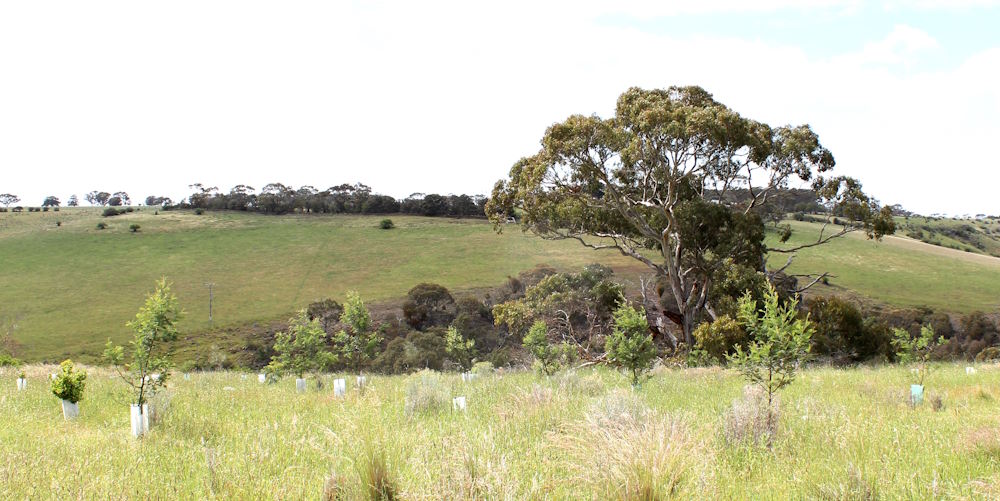
In 2023 we set up audio recorders for koalas on a new and wonderful planting site on the banks of the Moorabool River in Victoria. A few months earlier that year, we had planted over 3600 koala trees and shrubs in partnership with the International fund for Animal Welfare (IFAW).
Together with IFAW, we were hoping to get a sense of the numbers of koalas on the property, and how long they stayed (a baseline), before the planting made a difference.
In 2024, we followed up with another series of audio recordings. The growth in koala observations blew us away!
But let’s go back a step. How many koalas were there before planting?
Based on site assessments we had done in 2021 & 2022, we didn’t expect many koalas to be using the property. The corridor of suitable food trees was too narrow, with pasture grazed by sheep on both sides. The soil was fertile, and had once been a Manna Gum and Swamp Gum forest – both species preferred by koalas. The river was right there. We had landowners dedicated to returning habitat for koalas. It was perfect.
Discussions with the landowners confirmed our analysis – they hadn’t seen a koala for over a decade.
In 2023 we recorded four koala calls. The numbers were not high, but we could see there was potential. It confirmed that koalas did visit and would find the new habitat when the trees grew.
The calls were spaced a week to ten days apart. Which suggests that the koala visited for a short time, saw no habitat, and moved on.

Fast forward to 2024 koala breeding season.
We installed the same audio recorders in the same places. We didn’t expect much change – the first 3600+ trees were just 18 months old. Some of them were over 2m high though, and we know that even 2 year old trees can be used by koalas*. The trees planted in winter 2024 (7700+) were just 6 months old, and much too small to attract koalas.
But when I got the headphones on, I was in for a surprise.
The number of calls had tripled, and more.
I was hearing multiple males, who were staying longer. I even heard a female yelling at a male! That’s breeding behaviour!
Here’s a breakdown of the times of the calls. You can see from the calls that are close together that some of the males are staying around and calling repeatedly.
Location 1
November 15: 10.02pm (this is male 1) Listen: https://inaturalist.ala.org.au/observations/355954714
November 16: 12.34am (can’t identify) Listen: https://inaturalist.ala.org.au/observations/356663651
November 17: 05.33am (this may be male 3 – see below – or male 6) Listen: https://inaturalist.ala.org.au/observations/356663989
November 20: 05.36am, 10.10pm, 10.36pm, 10.40pm & 10.41pm Listen: https://inaturalist.ala.org.au/observations/359738790, https://inaturalist.ala.org.au/observations/360126400, https://inaturalist.ala.org.au/observations/360125760, https://inaturalist.ala.org.au/observations/360124921
November 21: 01.09am to 01.12am: MATING!! a female calling for over a minute, followed by a male calling (softly), then both female and male calling. Listen: https://inaturalist.ala.org.au/observations/360117827
November 21: 01.46am & 05.25am Listen: https://inaturalist.ala.org.au/observations/360127553, https://inaturalist.ala.org.au/observations/360128172
Location 2
November 16: 10.26pm, 10.27pm and 11.07pm (these are all male 2) Listen: https://inaturalist.ala.org.au/observations/355962006; https://inaturalist.ala.org.au/observations/355962921; https://inaturalist.ala.org.au/observations/355985772
November 17: 12.07am, 06.01am (these two are male 3) and 06.35am (this is male 4) Listen: https://inaturalist.ala.org.au/observations/356375457; https://inaturalist.ala.org.au/observations/356629289; https://inaturalist.ala.org.au/observations/356782450
November 18: 1.31am (can’t identify), 10.09pm and 11.15pm (these two are male 5) Listen: https://inaturalist.ala.org.au/observations/355985338; https://inaturalist.ala.org.au/observations/356784126; https://inaturalist.ala.org.au/observations/356782882
November 19: midnight 12.00am (this is male 5). Listen: https://inaturalist.ala.org.au/observations/356629803
How do I know it’s not all the same male calling? They sound different! Male koala bellows are individual and distinctive. The bellow is made up of a low frequency, simple repeated note, ending in a higher frequency complex note across a few ranges.
At Location 1, we have two calls with the low note in the frequency range of 0.2 to 0.4kHz; and one call in the 0.1 to 0.3kHz range. The high frequency note is at 1.1 to 1.4kHz in the very low one, and at 2 to 2.4kHz in the other. The third is too difficult to hear. The other nine calls I’ve only just found, and not analysed yet.
At Location 2, we have five calls with the low note at 0.1 to 0.4kHz, and one at the very low 0.0 to 0.2kHz (male 4). Then three calls at 0.3 to 0.6kHz that are definately the same fellow (male 2) – the calls are only 1 minute, and then another 30 minutes later. Then when I look at the high frequency complex note, I can see that the five calls with the low note at 0.1 to 0.4kHz are two different males (males 3 & 5).
So I think we have at least five males recorded here, and possibly six. There are two calls too distant or messy to decipher.
What’s really exciting, is that all this is has come from just two locations out of the four. There’s another two I haven’t analysed yet!
..
Could tree planting for koala really work this fast?
Yes, it can. Scientists have tested other tree plantations in NSW and found that koalas can start using trees as young as 2 years old. Some of these trees are still in tree guards. If it has leaves, a koala can eat it.
For animals desperate for quality food, a tree planting project can be a lifeline, in no time.
Only specialised koala tree planting is likely to be a solution.
This is not a case of ‘if you build it, they will come’ but more a case of ‘if you build it properly, in the right place, they might come’
Koalas have very specialised needs. A successful koala tree planting project will have most of these features:
- A connection to a nearby koala population.
- Large size, preferably a broad block of 100m wide or more, and thousands of trees.
- A river or permanent watersource.
- A planting of diverse native species that can form a natural ecosystem in time. Eucalypts alone are not enough.
- Eucalyptus trees that are known primary food trees with low toxicity.
This is what we do at Koala Clancy Foundation. Our methods are constantly evolving towards better, faster, more diverse plantings that survive to become ecosystems.
..
This exciting news comes just in time for the tenth anniversary of Wild Koala Day, on May 3, 2026. See how you can get involved, from anywhere in the world here.